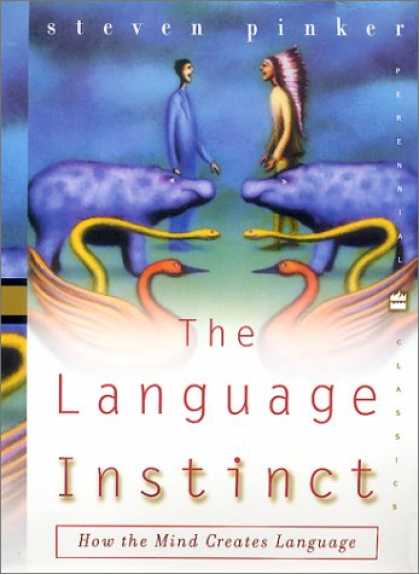
The Language Instinct by Stephen Pinker (2007)
Summary: This book describes how a parent can have bad grammar while the offspring has excellent grammar. It goes over how “by modulating the sounds we make when we exhale,” language changes and transforms over generations to fit the groups needs and is reinforced by use. Syntax is very important when no other clues are given and how sarcasm is so imbedded in some phrase, we might not be fully aware of it as we’re talking.
Review: A linguistical fantasy. Every turn of the page is some interesting fact about a phrase we’ve taken for granted. For example, did you know that “data” is a plural noun? Or that “slim chance” and “fat chance” mean the same thing? I am sure that it makes sense and you could claim to know that, but to really appreciate the idiosyncrasies of language, I think it needs a second look.
Rating (1=regretful read…10=My New Favorite Book): 7 oronyms
Favorite part: Words depend on context. For fun, here are some sentences that sound similar but mean differently.
“The good can decay many ways.
The good candy cane came anyways.
The stuffy nose can lead to problems.
The stuff he knows can lead to problems.”
Wine-pairing: A Clockwork Orange by William S. Burroughs (1962). He creates a language to color his ultraviolent world, mixed with Cockney, Russian and mischief. After a while reading it, you fall into thinking with his words as paprika mixed in with the rest of your typical lingo.
 Katarina Countiss