• In my scrolling of social media consumption, I saw a photo of an acquaintance that was an artist portrait that looked authentic and accessible and I wanted that. I booked the photographer and she was really easy to communicate with and establish the logistics for our photoshoot. Check out her website here, highly recommend for hi res portrait photography website.

    I reached out to collaborators for participating and Andrew was available and interested. We brought props and costumes to the location and Kayleigh was punctual and ready to photograph. We took photos for a bit over an hour. 

    What I like about the photo shoot is what you see is what happened. I like this about documentary style photography is the underlying paradigm that the thing you are witnessing in the photograph is real. It feels so important and meaningful to have that style of media where it feels like a promise that we didn’t doctor this or make it up wholesale, but it’s a historical moment in the tapestry of ordinary/artistic life.

    I connect with this a lot and I made one of the photos my profile picture because I felt good about being captured doing something I love and with full feeling, not performing for my selfie, but allowing myself to drop in and relax in my body.

    Andrew was a comforting and inspiring presence and I liked that Kayleigh captured him in a way that I also see him which maybe validates the way that I was captured. Sometimes with photos, one can think that there’s some distortion of perception based on the fact that you see yourself all the time in the mirror, so there’s a familiarity and so a portrait of oneself sometimes doesn’t always feel like a portrait, but a mirror. So to see someone else looking like themself in an image makes it all work in my opinion.

    I’m also really intrigued about “orange work.” We did some duo authentic movement with props and engaged with two oranges. The feeling of the prop being a food, a fruit, there’s a feeling of familiarity and novelty and I’m looking forward to incorporating more in future authentic movement explorations.

  • Social Media Encouragements

    Kat has a prolific and inspiring internet presence sharing their craft creations, artistic musings and learnings. I appreciate the candor and class of her content, plus I’m always intrigued and left thinking about the world with fresh perspectives from her posts!

    Kat is a joy for any artist to follow. I love seeing their creative musings and playful expressions in my feed. Watching them showcase their own and their communities creations helps me stay inspired to pursue my apparel design even during sewers block. I am grateful to learn by their example online.


    Kat assesses the world around her well, which contributes to the frequent posts she makes which I find inspiring.  And her creativity is demonstrated through the projects she shares, and the events she organizes.  Her voice feels unique, her word choice, deliberate, and her messages stimulate creativity within me.

  • (To be performed like Icelandic ASMR)

    At the scale of the crystal and lattice

     to satisfy a number of objectives, 

    the value of the local friction coefficient 

    For the highly complex assemblies found in practice. 

    The difference in thermal expansion between the inclusion and the Matrix, 

    Many appropriate Solutions. 

    Sufficient to keep this potentiality between Simplicity and efficiency. Considering this parameter through cluster morphology In the current techno ecological economic context, especially if the experimental procedure is not well adapted On a plane elastic solid Can be experimentally observed from the thing Edge, Leading to the consideration of a mean stress. The responses are compared to each other. Different approaches can be found in the literature. This ratio remains a reliable indicator Whose alternate and average Play different roles. It constant amplitude, But with different ratios That is not equal to zero. Predict some degradation phenomenon. The correct directions regarding the loading within the critical zones Are similar to those determined on the volume due to the Symmetry of the problem. By considering the effective tensile fraction amplitude This to generate a range of values. 

  • Ethos

    Unwinged

    Method

    Attention

    The Question

    Meditation

    Dismantling

    A Capacity

    Erosion

    Something Other

    Awakening

    Vigil

    Fragments

    The Archive

    Ethos

    I view these experiments in self-undoing,
    Not only as self-unbinding practices,
    But also as practices that bring to the fore
    All the fraught ways I am bound
    By my time, ethos, and ethics.

    I try to practice noticing and surrendering—
    To cultivate a way of speaking
    That steps away from the moral habit of telling others what to do.
    Unbinding is suspension,
    An experiment in limits and experience
    That suspends the murmur of unreason,
    Called Eros.
    Multiple readings—queers with feminists.

    That temporal paradox,
    Edges of a time that borders my own
    And is therefore, others to me.

    The form of sexual identities I hold dear,
    Even as I increasingly bristle against them—
    The concrete and abstract,
    Utterly real and unreal site of inventive normalization.
    A murmuring collapse of speech and meaning,
    A method that engages with unreason
    In ways that suspend and transform everyday practices of living.

    The poetic speech of an exteriority that erodes.
    I have listened for the murmur within the grid
    As an archival noise that constitutes the I—
    Incremental differentiations of a gradational logic.

    Beginning from a place of suspicion that views morality as catastrophic,
    And challenging the queer habit of rejecting normativity
    And celebrating the non-normative.
    In what was once called a “good dog, bad dog” rhetoric of puppy obedience school,
    That simply reverses and thereby perpetuates
    The good vs. bad moralizing gestures
    Queer theories have claimed to disrupt.

    Not an exclamation point, but an ellipsis—
    An erotic unraveling into something other than sex.
    And with that unraveling,
    The cultivation of an attitude,
    A different abode,
    An emptying people’s space—
    Thinking as an ethical practice of freedom.

    The murmur I heard began to gnaw
    At the sexual moral frames by which I had been bound,
    Embraced, and rejected.
    This quiet erosion as an ethical release—
    Not a full-throated leap,
    But the un-knotting and loosening of a fabric.

    Unwinged

    Its anachronistic strangeness leaves it unwinged,
    As Ann Carson puts it—
    A noun, whose spirit remains trapped in the lungs, unspoken.
    In itself, a silencing withdrawal of meaning,
    Eros hollows out the subject-object doublet
    That structures sexuality.

    For those committed to speaking and thinking
    Within such disciplinary and regulatory forms of confinement,
    New resources are required—
    For speaking and thinking.

    There is no outside.

    Method

    I focus my attention on the abstract and unseen operating system.
    The archive’s double meaning is difficult to grasp.
    The two meanings do not cohere into the unity of understanding—
    Rather, they undo the philosophical idea of coherence and unity.
    There is something heterotopian about this double understanding of the archive,
    As both concrete place and abstract operating system—
    As both visible and invisible.

    How might we track the movement in the archive?
    Truth, history, and life itself—
    All fundamental elements of biopower—
    Are made, fashioned, invented.
    That fictioning is poetic in its transformative sense.
    As something fashioned, a fiction can be re-fictioned,
    Refashioned.

    In the border-suspending encounter,
    The archive becomes an ethical invitation—
    To philosophical investigation as an aesthetic practice.
    The encounter between nowhere and known,
    A practical art that transforms the poet
    And those who hear her—
    In terms that are ethical,
    Making ethos, producing ethos,
    Changing and transforming ethos.

    Attention

    In this recursive movement,
    It offers poetic strategies for cultivating attention—
    That extreme attentiveness that comes with waiting,
    The attention of atente,
    The acute awareness of what is radically new,
    Repeatedly eroded by half-said truths,
    The unsaid or the unsayable.
    Sound disposed on a page,
    Erotic rhythm, arrhythmia—
    More staccato than glissando.

    It lays bare the places where the mosaic is frozen,
    Broken, its peace and pieces missing.
    Disintegrative and rift-restorative,
    Frayed fragments of an erotic art.
    This is my attempt to address that perplexity.

    The murmuring background of a movement
    That scatters,
    In the spirit of conversation,
    And eagerness for the challenge
    To explain that which resists explanation.

    The Question

    This ethics does not take its own beginning as a given—
    It begins by questioning,
    By putting its own beginning in question.
    This self-questioning exposes ethics
    To the radical contingency
    Of its own violent formation.

    The modern psyche, or soul,
    Whose sting of consciousness disciplines
    Subjects into governing themselves,
    Into the self-repugnance called ressentiment,
    Half imaginary, half real,
    And yet to be lived.

    Try to love the questions themselves—
    Like locked rooms, like books
    Written in a foreign tongue.
    Do not just strive to uncover answers—
    They cannot be given to you,
    Because you have not been able to live them.
    Live the questions for now,
    And without noticing it, perhaps
    You will gradually live your way into the answers.

    Meditation

    These experiments in living
    Are not self-indulgent, hedonistic forays,
    Nor drug- or sex-induced limit experiences—
    They tend to be quiet, sober, and recursive.

    As meditation, these quiet practices of ethical subjectification
    Are less explosive than they are erosive—
    Like gullies hollowed out over time.

    This describes a self-undoing
    That necessarily occurs in relation to others—
    A self-hollowing,
    Relational erosion of edges,
    Within and outside,
    Despite the self.

    This is the result of self-othering,
    A surrender to something larger than the self,
    Like the gullied rainstorm,
    Season after season.

    Dismantling

    A movement of self-release—
    Dismantling of self,
    Rather than its negation.
    A subtractive, recursive,
    Disintegrating submission to something
    Larger than I am.

    Eros springs in ecstasy,
    Larger than the self.
    The lover belongs not to,
    But with the beloved—
    Like the thought of the outside
    Whose movement intrudes
    On the subject’s interiority,
    Drawing it out of itself.

    Divine yearning places the lover
    Outside of herself
    In the loving care she has for everything,
    So that she may come to abide
    With all things.

    But the lover achieves
    This erotic union with all things
    By virtue of her capacity
    To remain within herself.

    Going outside of oneself
    Is done ultimately to find oneself—
    To wrap and gather oneself
    In the dazzling interiority
    Of a thought that’s rightfully being
    In speech.
    In other words, discourse—
    Even if it is the silence
    Beyond all language,
    The nothingness beyond all being.

    A Capacity

    A capacity to affect
    A unity and alliance,
    In our particular co-mingling
    In the beautiful and the good.

    It binds things of the same order
    In a mutually regarded union—
    An ordinary ethics of everyday life
    In which Eros names a desire
    Larger than the self.

    Something larger than the “I,”
    A capacity for sustained relationality
    That she also calls freedom.

    The ethical effect of attunement with nature,
    In the rapport between dissonance
    And disconnection.

    The desire for an ideal
    Repeatedly fractured
    By the arithmetic violence of the real.

    Eros opens towards refreshing plays,
    Refreshing places,
    Refreshing spaces of comedy and laughter.

    Erosion

    An ideal integrity disturbed
    By a movement of disintegration,
    Whose resulting parts—
    Like puzzle pieces waiting to be put together—
    Have somehow been extracted
    From that originary whole.

    This dissolves interiority,
    Bringing out the paradoxical relation
    Of centripetal and centrifugal forces.
    A simultaneous binding and unbinding
    That does not come to rest in completion.

    This restlessness is the erosion
    Of dialectical sublations,
    Victory, or right to victory.

    Repeated gestures in history
    Leave in suspense
    Anything that might take on
    The appearance of an ending
    Or a rest in truth.

    Something Other

    What was scattered gathers.
    What was gathered blows apart—
    A function of impermanence, time passing,
    An inward movement.

    The tension in conjoining
    Pushes things apart.
    This chaotic formulation:
    Earth to seed,
    Earth speaks and unspeaks
    Across a binding, unbinding.

    That “I” is not a substance, but a grammar—
    A present to hold lightly.

    To work gropingly is to linger over the ambiguity,
    Meaning-making as the temporary result
    Of a temporal sedimentation.
    This erotic movement dramatizes
    The tracking of meanings
    That fade over time
    Without disappearing altogether.

    Eros emerges
    Out of a series of strange grammatical shifts—
    Moves and murmurs as a verb.

    Something like capacities,
    Conditions of possibility,
    An unstable conditioning agency.

    Something other than domination,
    Something other than discipline,
    Something other—
    Practice is a freedom
    That coheres and dissolves us.

    We extract ourselves as truth
    From a background that falls away,
    Intruding on that self-speaking
    Extraction of truth, and its occultation.

    Not a crossing of a line,
    But a suspension of the relation
    That gives us the line,
    Opening at the heart of the limit—
    A non-positive affirmation.

    Awakening

    Distances, disperses of faces—
    Loosens.

    Awakening and releasing
    My cravings, my aversions,
    My disciplinary attachments,
    My unquenchable wants.

    What is flickers,
    Stereoscopically with what could be—
    Something undisciplined,
    Awakening a formless murmur.

    Something shifts in that unsettling,
    The goal of allowing refusal, curiosity,
    And innovation.

    Ways of existing,
    Styles of life—
    Inventing a possibility of life,
    A way of existing.

    A transmutation of the real
    Through a free play of attention,
    If theoretical practice.

    A not-at-all personal mode of invention
    That opens other possibilities for existing.

    How will we breathe inside the techno grid
    That puts us under surveillance—
    And in turn, each of us
    Becoming evermore effective
    In surveilling ourselves,
    And so many others
    As so many forms of life,
    As memes, selfies, internet,
    Ad-junkies, and pixels?

    I watch,
    Whereas GPS-driven motorists
    Suck the grid.
    Might Eros teach us
    To veer off course,
    To get lost—
    To keep living
    By holding living?

    Vigil


    Open as a question when that loosens us.
    More questions, whipping me into shapes
    That are not quite me—
    Twists, like a whip, folding and unfolding
    Or cracking to the rhythm of its utterances.

    The French verb is veiller—
    To keep watch.
    From the Latin vigilare—
    To provide for, to care,
    By watching, keeping watch.
    As veiller means staying awake,
    In the night, remaining alert
    During the time usually consecrated to sleep.

    Veiller is thus the verb of palliative care,
    A caring attentive to the fact of dying,
    Without knowing when the dying will come.

    Its etymological roots in the Latin vigilare
    Also link it to the Latin vigil—
    The eve of a religious festival.
    These occasions of watching,
    Bending down as in prayer,
    Are also acts of devotion.

    Fragments

    The way that a poem breaks off
    Leads into a thought that can’t ever be apprehended.
    There is a space where I thought it would be,
    But which you can’t get a hold of.
    I love that space—
    It’s the reason I like to deal with fragments.

    A poetic, disintegrative approach to thinking and speaking:
    The breaks, the gaps, the discontinuities.

    The conception of history is whole, written, and incomplete.
    A free space of imaginal adventure
    And embodied aging,
    Inhabitant of a wonderful and devastated planet.

    That thought speed—
    That thought space opens,
    In movements of self-doubling and deviation.
    Even the absence of structure is a structure.

    Defective fragments.

    How long must something be
    To cease being a fragment?

    The Archive

    The lover, the beloved,
    And that which comes between them—
    Three points of transformation
    On a circuit of possible relationship,
    Electrified by desires,
    So that they touch without touching, conjoined.
    They are held apart.

    The sphere has become a thing full of holes,
    With the figure of the spiral.
    Something disappears
    And returns with a difference.

    An unconditional return,
    And an absolute plunge—
    Its vertical dimension.
    And the strange return
    Allows us to hear the distant background noise
    Of which reason’s time was extracted.

    I feel it reverberate,
    Like sounds in a room.
    That room is our archive,
    A complex volume of events and things
    That we call our historical present.

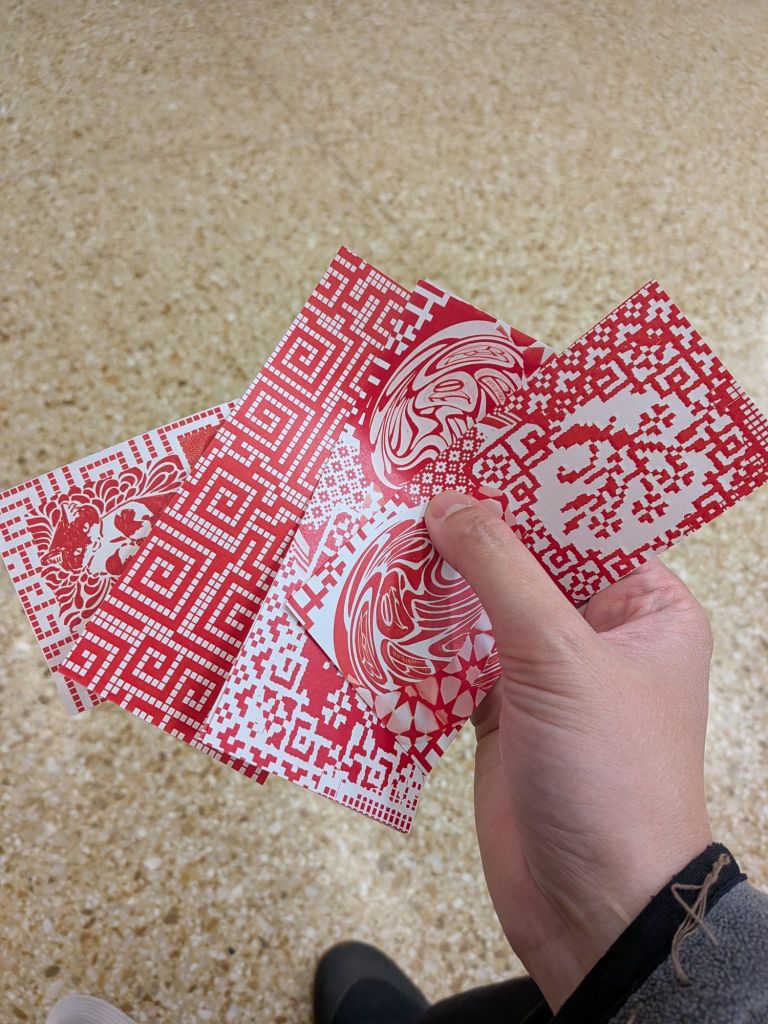
  • I’m enjoying the transmission of squares. The meditation is graphic, scales well, is symbolic and abstract, accessible and calls back to different levels of craft in terms of pattern building. I made some of these designs using Excel which gives you great control and grid, and every computer has a version.

  • I was challenged by my partner to learn about tilesets and I created this using https://www.aseprite.org/

    Pretty great experience learning a new tool, but motivation waned after completing it on my own. I have mild aspirations to be a part of a game jam some day.

    late posting about this, was working on this in late december.

  • Deep breath, an exciting moment in manifesting — using the new year’s vibes to start again on spurting out intentions and allowing myself to explore, but also keep things top of mind. I think there’s also a social component in that other people might be looking to do some of these activities– plot hooks that you know I’ll bite.

    Perhaps, that’s a low-stakes intention that I have with the thing is being more transparent about what I what to receive or collaborate on.

  • The Right Use of Power is about the heart of ethics.

    Barstow, Cedar. The Right Use of Power: The Heart of Ethics. Many Realities Press, 2015.

    I think this is a really important book for program designers, especially when you have a population—say, students, patients, or a community—where you’re providing services.

    There is a power dynamic in play. Participants in a program are often in a down-power position, while administrators and faculty delivering the services are in an up-power position. This can get complicated because your stakeholders may also be empowered and contribute to decision-making in the program.

    I’ve noticed this especially with data collection and being a participant in programs myself. The opportunities to shape your experiences are often very underutilized or under-leveraged. What happens instead is that you do a survey with very little shaping of the conversation.

    Because of that, I believe these two books together work really well—creating more agency in teams and communities while acknowledging the mechanical issues of hierarchy and leadership.


    Social Work, Voice, and Program Design

    Glicken, Morley D. Real World Clinical Social Work: Find Your Voice and Find Your Way. Routledge, 2011.

    Find Your Voice (from a social work perspective) is similar. When I talk about arts organizations, I am really talking about a lot of social work.

    Any team or community can benefit from a deeper understanding of social dynamics and the needs of their constituents, which often have a social-emotional component.

    For me, my theoretical orientation was one of the reasons I sought this out. Even if you are not a Master of Social Work, having an idea of why you are doing what you’re doing—and what strategy you’re taking from a social or psychological approach—really matters.

    I’m very driven by the idea of behavior change. But behavior change comes with a variety of approaches, and if those are used inconsistently, it’s like a bunch of darts being thrown randomly.

    I also appreciate how this book describes the challenges of being a social worker—or really, a nonprofit worker—and being aware that there are trade-offs to doing work for people. Finding your setting is key. There are many settings where this kind of work happens, and finding alignment between your mission and your framework is crucial.


    Relationship Housekeeping and Keystone Conversations

    Another book I recommend is How to Work with (Almost) Anyone.

    Bungay Stanier, Michael. How to Work with (Almost) Anyone: Five Questions for Building the Best Possible Relationships. Box of Crayons Press, 2017.

    I really appreciated this book because it talks about your best possible relationship and five key questions to have in a keystone conversation—questions that help guide and anchor you when there are troubled waters.

    I think of this as relationship housekeeping, and I consider it really important. I’ve had problems with teams in the past where we couldn’t agree on something, and having shared reference points—and self-knowledge—to rely on makes a difference.

    These five questions are essentially about:

    • Knowing your preferences
    • Knowing your best qualities
    • Understanding what the dream of the best possible relationship looks like
    • Naming what you’re striving toward together
    • Reflecting on when you’ve been burned in the past and what you learned

    You uncover truths that are not easy to talk about, not easy to face, and not easy to uncover. But that difficulty can lead to really rich outcomes. You get lost, you see things you wouldn’t normally see, and you move through the wilderness of organizational culture.

    When you’re passionate about something and want to create change, you inevitably push against people and find boundaries. It can get charged and emotionally draining, which is why this kind of grounding framework is so useful.


    Tracking Pain, Momentum, and Strategy

    The book on pain tracking was one I really enjoyed.

    Barrett, Deborah. Paintracking: Your Personal Guide to Living Well with Chronic Pain. Paperback ed., Feb. 21, 2012.

    Part of what resonated with me was its approach to accepting chronic pain—changing your attitude about it and deciding, “I’m going to manage this.” It emphasizes finding people with different practices and interventions that can actually work.

    The book describes ways of becoming more organized in your strategy: analyzing what you’ve tried, what has helped, and what hasn’t. There’s even a nice idea of having a kind of resume—or CV—of specialists you’ve worked with in managing symptoms.

    I found that really hopeful. It takes as a given that you’re going to need specialists with orientations that understand your particular set of issues.

    I’m still thinking about how this relates to my own challenges—especially maintaining momentum on projects. I wonder whether tracking projects, or tracking myself through projects, could help me find a sense of pacing: when to push, when to rest, and how to develop a more diverse portfolio.

    I find this framework intriguing for developing strategy—getting a clearer picture of what the real problem is. I’m looking forward to experimenting with more types of tracking and interventions.

    I also think this framework could be really useful for analyzing creative blocks, understanding where a team is over time, and figuring out how best to work with people who have different strengths.


    Making Ensembles and Understanding Roles

    The last book in Kat’s Reads is Ensemble Theatre Making: A Practical Guide.

    Bonczek, Rose Burnett, and David Storck. Ensemble Theatre Making: A Practical Guide. Routledge, 2013.

    I really appreciated this book because it describes group dynamics using archetypes and looks at what happens when certain people drain the group rather than contribute to it.

    Reading this was very inspiring for me as a leader. I realized I didn’t fully understand how to support different roles in an ensemble. I’m looking forward to revisiting its ideas around auditions, analyzing people’s strengths, and categorizing roles—so that when I’m creating a team, I know what I’m actually looking for.

    It’s not about finding the same person over and over again. It’s about alignment—bringing together people with diverse skills and orientations, and thinking seriously about job sculpting.

    This came up for me in volunteer work I did this year, where leadership wasn’t clearly delineated. I’m fairly sure every volunteer who applied was accepted. Maybe part of the solution is framing the first shift as an onstage moment or a tryout—an opportunity to see whether you like the style of work or management.

    I think it’s important to be able to say that some volunteers are not a good fit—not as a value judgment, but as a way of protecting everyone’s time and energy.

    This connects to issues I’ve had in previous art collectives: role confusion, uncertainty about what kind of contributor you are, what kind of leader you are, and how leaders and contributors can work together toward real accomplishment.

    That means being clear about agenda, time-boxing, time commitment, and expectations—so sessions aren’t draining, but instead build momentum and stay aligned with why people joined the ensemble in the first place.

    I really appreciated how this book names group dynamics, describes archetypes by behavior, and even talks about gray areas—people who aren’t “problem archetypes” but have tendencies that might need to be addressed more directly.

    Leadership, to me, is about understanding who your team is and aligning people with shared objectives. It may not be an overnight transformation, but there are ways to coach people into working with others in ways that honor their strengths.


    Closing

    That was Kat’s Reads.

    I hope this set of books gives a sense of my interest in developing strategies that help teams and communities work better—more ethically, more sustainably, and with greater clarity.