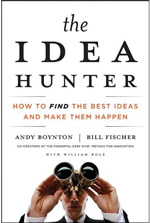
The idea hunter: how to find the best ideas and make them happen / Andy Boynton and Bill Fischer with William Bole. San Francisco, CA : Jossey-Bass, c2011
Summary: The authors structure their take on creativity and how to cultivate better ideas through the acronym of IDEA (Interested, Diversity, Exercise and Agile). It’s about cross-training your mind and developing a natural curiosity.
Review: This is a fairly short contentless book. It cites textbook examples of the new millennium’s in vogue creative, from the people at Pixar to the person who invented the light-up toothbrush. The authors start with Walt Disney himself. Disney is portrayed as a copier/innovator of the people from Tivoli Gardens when designing Disneyland. This book is forward enough to say that small innovations are enough. They are for this capitalistic world where most people have resigned themselves to a non-creative life. At least from what I can see.
Rating: 4 atriums in Pixar Studios, where animators and sound techs can mix freely and fruitfully
Favorite part: “Accomplished people don’t bulk up their brains with intellectual calisthenics; they immerse themselves in their fields,” explains Steven Pinker. “Novelists read lots of novels, scientists read lots of science.” P.72
Wine-pairing: The creative habit: learn it and use it for life: a practical guide / Twyla Tharp, with Mark Reiter. By Tharp, Twyla. New York: Simon & Schuster, c2003. Twyla’s creative habit of “tech boxes” is interesting and useful for organizing ideas for one project. I think it’s important to keep track of your seed of inspiration and following where your muse takes you. “Tech boxes” are physical boxes containing scraps of inspiring materials that sit at your home or studio waiting for you to revisits’ them and become reinspired.
 Katarina Countiss