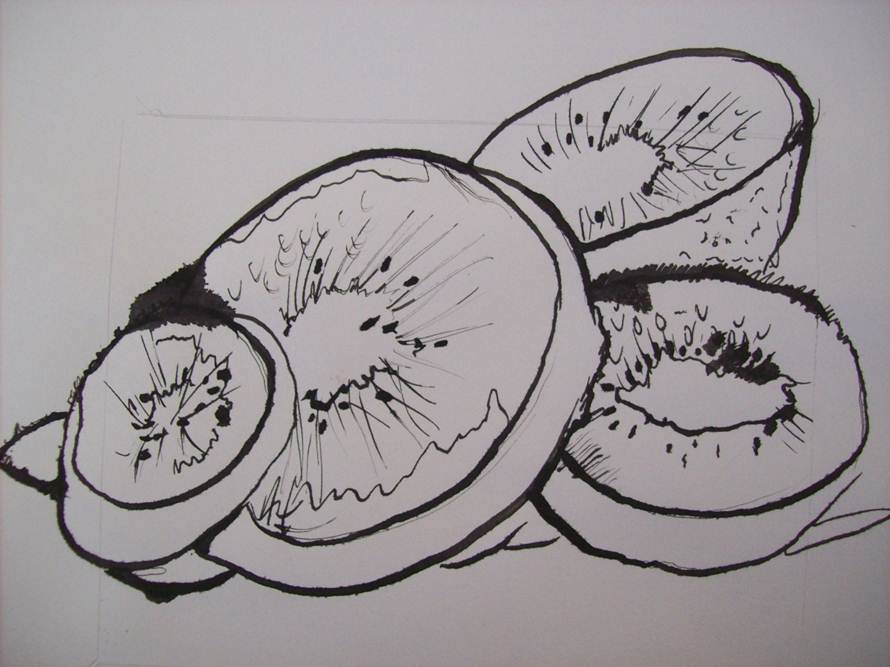
I don’t sketch a lot. It detracts a lot from the spontaneity of the work. But, I don’t think people want spontaneous design. I think that’s an oxymoron. Design is a mindset. It’s solving a problem, shaping an experience, optimizing environment. It may look spontaneous, and a couple of my teachers would assert that if it looks effortless, that’s good design. And sometimes it is the first thing you scribbled on a page, but many times it isn’t. That’s where sketching comes in.
Sketching is extracting ideas from your thought process to something more permanent, as we all know the fleeting moment where you realize that you just forgot your fantastic dream that seemed so strange you thought you could never forget it. For me a sketch seems cosmic, like predicting the future. Showing a path of the future (if you believe the Many Worlds theory), it is just showing an option among many. That’s what creation is. We can acknowledge how the world can be any which way, animals with three eyes, or made of light waves, but the creation comes with putting it to paper (or canvas or writing or whatever form really). The creation happens when other people can refer to it as an idea over and over again. Where the fact that other people are thinking that there are 3-eyed animals is no coincidence but something that you suggested to them.
A good sketch is something that will inspire you to make that suggestion more real. Each rendering that improves with some aspect of refining that idea is a step towards making a sketch a reality, making a suggestion a creation.
This process is tricky. Jill would say “What do you like about this?” It is a matter of refining your design to the essential elements. She would say “What is working?” Each incarnation of your sketch gives different hints as to its true essence, but also, medium comes into play. When sketching with a pencil, the density of the marks can play with the light-darks of the design and indicate something very subtle but transformative to your design and as it’s being created you might not have thought it could be any other way and that cements a certain route in your process for the rest of the time. Perhaps you try to render that same idea using ink and brushes, the line quality and the saturation pushes to the forefront of priority and in refining that idea you try to maintain those qualities. I told Jill this idea about medium, the difference between sketching with a marker versus a pencil and she said that it didn’t really matter (I don’t know if she was tired and didn’t want to get into it), but of course her stance on computers in the process reflects this notion. I am merely stating that even if you start designing by hand drawing, I would heavily argue that medium changes your approach as you go. Each stroke and flourish look differently depending on the force and material you use in making it. A nice stroke can almost be an accident, a burst of energy and a flick of a wrist can be practiced and perfected over time, but is initially not fully under control. Line quality communicates emotion. Subtly, the line can indicate surety, boldness or more tentative energy.
“In design dialogue, the wobbliness of the lines often expresses the degree of clarity of architecture thought. One does not sketch with a 6H pencil and a straight edge or make working drawings freehand with a felt pen. The refinement of a project is a step-by-step process of sharpening both the compression and representation of one’s image of the problem.” Nicholas Negroponte, the Architectural Machine
The other side of the coin: playing to your strengths. I personally dislike the traditional pencil sketches because I don’t see myself as a drawer, someone focused on details, shading, realism, that sort of thing. I am a sketch artist, where each sketch calls out to me, “save me, save me, I am art, too!” and so naturally, I want to render each sketch in something more permanent and finished looking than pencil.
As for sketching as a process towards a finished piece, I like its quick way of capturing an idea that would take words paragraphs to communicate. How round or lanky something should be, how it fits on the page, that sort of thing. I want to caption each sketch, for position only, FPO. I don’t want people looking at my sketches and thinking that the finished thing will look anything like that, because it won’t. The way I work, the floor plan may be the same, but the details, the smaller shapes will take a life of its own during the creation process. Sketching relates to storyboarding which is different than concept art. Storyboarding is just the structure under the story, angles and directions, a recipe for the first process (in a series between the start and finish of something truly something). Whereas the concept art is the mood board, the inspiration, the home base where you can rest to rekindle the flame of creativity, reminding you why you started in the first place– you had a vision of this thing that would exist with your help.
Finally as a last tip, the rule of art, is if you feel comfortable doing it, it will show. If you were born with a mouse in your hand and have a firm hold in a process that reminds you of where you are in the finishing of a piece, that will work for you. The thing about painting is: you’re done when you create all the details you want in the painting. And that takes time and between painting the background and the first figure, you might realize that you need to add more of a table or something. Painting and drawing, you literally start from nothing. The lag between idea and art is longer than on the computer where a fonts and images wait eagerly for you to pick them. So, the execution is quick. That sense of time is warped. Working on a computer is fast, so it pressures you to think fast. Whereas painting is a slow endeavor and when you invest time, you want to make it good, so the decision time is longer, more thoughtful. I think that’s what Jill is talking about when she says go to the computer last. Don’t necessarily go to the computer last (there are fonts and research on the computer) but go to the computer speed of decision-making last. Sketching is not about the act, but the time spent not committing to a particular design and trying out (in a way that is quick and efficient) different futures.
It’s also like trying on shoes. It’s comforting in the decision making process knowing what definitely didn’t work. I’ve had some shoes salespeople who said “try on this one, just to make sure you like the other one better.”
 Kismet Arts Tangent
Leave a comment