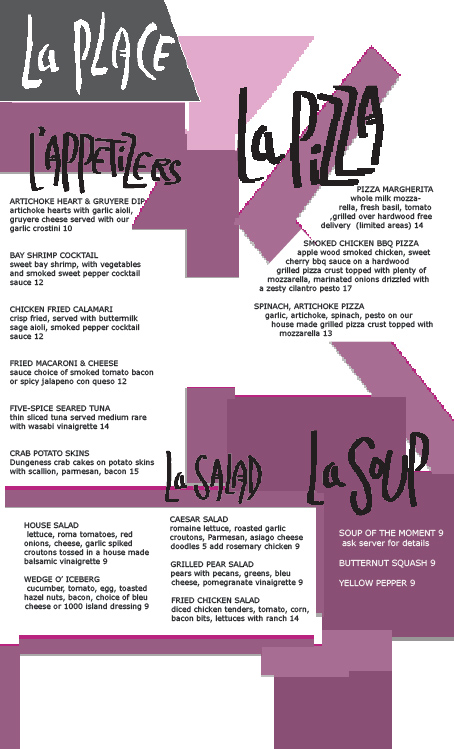
• purple menu for la place
    (sorry about the pixelation.) Screen grab from InDesign

    Today I presented this in class. After reading the first chapter of “Hey Whipple, Squeeze This” I realize that I shouldn’t have approached this menu design in the way that I did. This is my first group of things that I have designed in InDesign. One of the first quotes I came across in the book (I’m a quote-fiend and take anything in quotation marks to be something of sublime wisdom) and it said I should follow the rules first. So, although Jason chastised those of us who used two column layouts and center-stacked the type for the drink menu, he made the comment, “random.” On my work. I think a part of it was that I didn’t explain the angles and seemingly random boxes I adopted as my foster grid (instead of lining things up to the columns that align to the page, I used this). The grid is loosely based off of a Picasso painting. Though, people thought French when they heard “La Place” I was thinking Spanish. Spanish painter’s need a modern classy hangout where they can eat gravy fries.

    For my next layout project, I’m going to use restraint. I’m going to play by the rules and produce something that looks organized and elegant. That’s been something I half-envied in others’ work. I say half because I really stand by my approach and the phrase “student work” means a chance to play.

  • http://www.youtube.com/watch?v=Bfj3fQ_PE1o

    For more information about this project, check out last week’s post.

    Marc (during Friday’s critique) asked my team how we ended up with this idea of cities and IT for this New Media video. I said “visual analogies” because it’s what gave Chris an eyebrow raise and he said that’s interesting during our concept critique.

    During the initial brainstorm, the word association with all the components of our project, words: information, techonology, SCCC, school, we made lists. For information, sometime after the mention of the word “knowledge” I forget who said “blossoming flower” and I loved that. It resonated with me. Later when discussing how to integrate that, I looked out the window of room  5142 and there were all of these cranes.

    In subsequent storyboards, we discussed the use of overlays, and we had a scene with wires overlaid by a highway scene (this did not end up in the film, through some disorganization, but no regrets). Jill and Tim responded to that storyboard among the 35 or so we presented to them. @e went back and restructured them after Jill initially poo-pooed the concept of comparing old and new technology with pop-up interface components. Tim and Jill said that we should unify the metaphors. We had frames with comparing technology to paper airplanes, flower arrangement and bicycles and libraries. She liked the car scene and they mentioned cities, urban connection.

    But, how to tie that together… We went through a concept I called “Hello from the future” where a future-person congratulates SCCC on making the foundation for the cybercity they enjoy in that present day. My teammates said that was too complicated. So, I thought, how about a poem, (I was thinking like T.S. Eliot’s style. Lyrical and heavy.)

    The idea solidified when I went over the footage and snipped everything together, and made multiply overlays over the whole thing. That’s my fascination with video. Making a collage out of clips. It’s not a style that will work with every project. The beauty of creativity is that when you get specialists together, they bring their unique spin to the table and when it works, it feels fresh and special. I’m convinced there is a perfect font for everything and a musical piece that is just right. As a graphic designer, I am in the camp of assembly. I am convinced that these pieces are out there and waiting for me to put them together to create the visual puzzle that is just the right amount of incomplete to make people imagine what’s missing.

    (Earlier Post Relating to This Project)
  • 1)Scale and Position

    2) Think about the Negative Space

    3) Oh, god. I hate this font. Never use this again.

    4) Never stack type like this.

    5) What are you trying to say with this?

    6) This needs more work.

    7) Remember Scale and Position

    8)Weren’t you listening? I said not to use that font… ever.

    9)The vibration on these colors is really tripping me out.

    10)Don’t get defensive.

    11)Ironing out problems in the process is just part of the process.

    12)Just think of it as a real world exercise.

  • Post-critique:

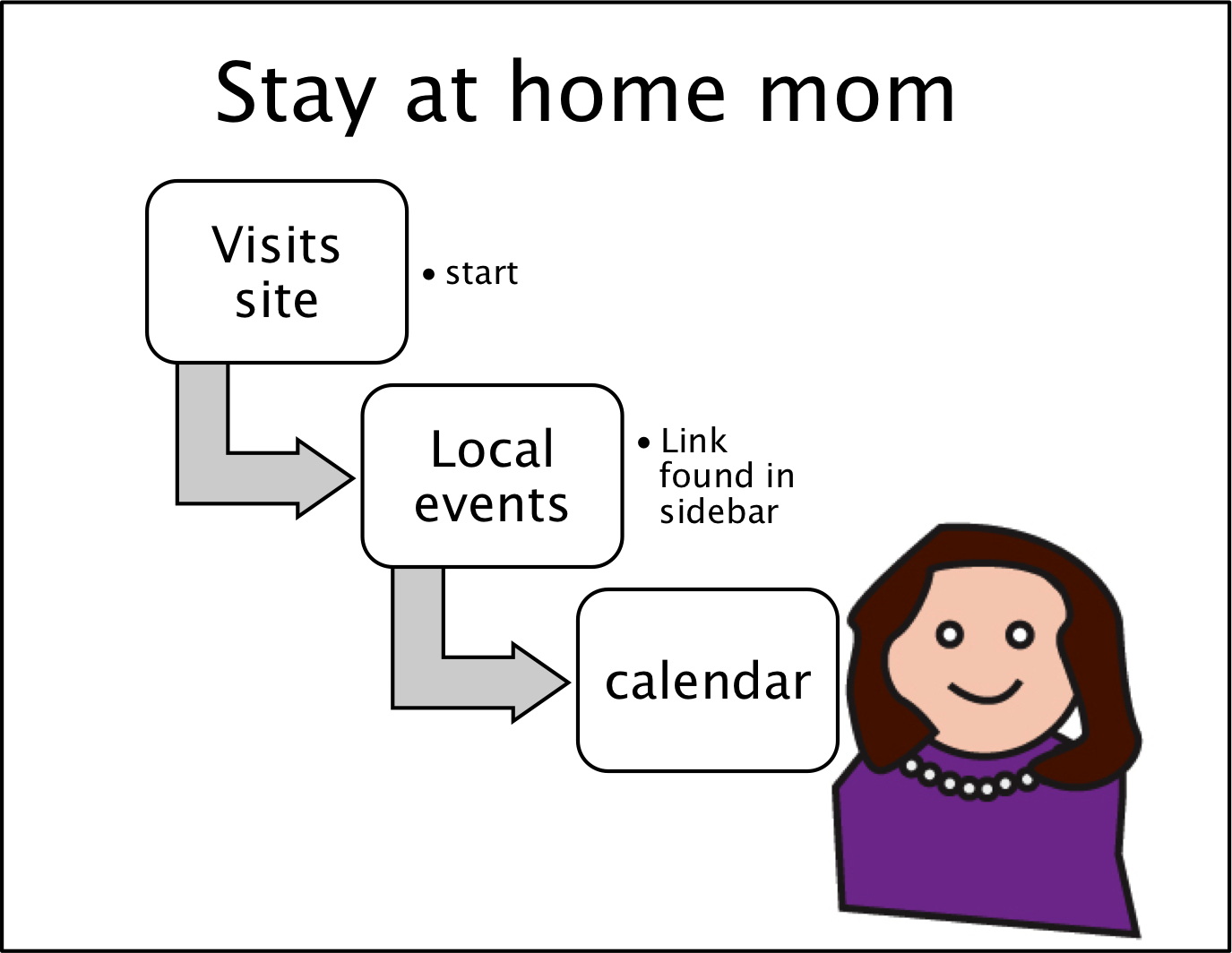
    Calendars in people’s presentations made Tim comment. Each calendar (online and off) requires a certain kind of engagement from the user. Will they mark x for days passed? It doesn’t stop at the calendar phase, the user finds a date he likes, perhaps an event he plans on attending and then acquires more information. Planning is the key and when you think about the user planning for fun or business, the outcome is organization. It’s about keeping all your information, concise, clear and standardized. A calendar mis-design is often to blame for missed fun. It’s our duty as designers to protect people’s fun, at least in this small way.

    During the class, Tim discussed how to control the user’s experience. There are considerations such as word choice (don’t put “crime” as a tab on your newspapers homepage). He discussed how flyaway menus are dying out due to the mobile device and the use of the finger as an interface manipulator. You don’t want the user to leave the site where you can’t control the experience. Give them enough information.

    He noted that one of the students had a “submit” page which is pretty standard for blog-y sites and felt it was a cold word to use for a Newspaper site. I never connected submit and submission before, but now I can’t get it out of my head.

    (Earlier Post Relating to This Project)

  • http://www.youtube.com/watch?v=Bfj3fQ_PE1o

    Project overview: produce video about 90 seconds long, in teams of three, PSA for an assigned Seattle Central Community College department, the video to be screened at a fundraiser, projected on a wall,  other music will be playing. (read: convey story without audio!) , 1 day to concept, 1 week to storyboard,  1 week to shoot a rough cut, 1 week to polish (three week time frame) We are at rough cut stage


    The team (Tim E., Erika– thanks for the brilliant footage!) gathered our video last night and I took it home to be the editor. (It is a lot faster when there’s only one person at the helm.) I sifted through all of the clips finding the little gem that makes a person go “oh!” the reason why the clip was taken in the first place, but sometimes just a lovely moment of honesty or a quick twitch that was interesting and unexpected. Then I strung all of those together and put the longer and more thematic clips on top, set to multiply, and almost there.

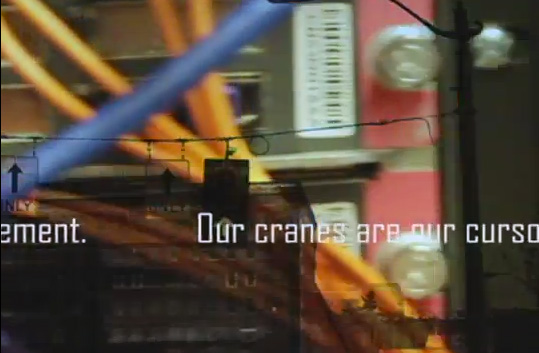
    To continue with the metaphor of systems administration being a city, I wanted to include lyrical sentences that would flash on the screen throughout the video, but I wanted to get this rough cut done, so I just made a long crawl of text. (Note: rough in my mind, means rough. At a certain hour in the night, credits, titles, and text in general are slapped together to form a concept and not necessarily a grammar-correct story.)

    Post Critique:

    Today it was just Marc. It was kind of a shame because I wanted to show Tim and Jill the progress (not much of what we had lined up with the storyboards we showed them, but the concept was planted in our minds during our critique with them.)

    Marc said that he liked it. He was impressed with the number of shots that we got and the music (when done right, it makes a POW!) he liked the music. I will have to email The Crystal Method to ask for permission to use their song (and put them in the credits).

    Improvements to make: get the crawl to interact, layer and vary. Let the crawl reflect the theme of connections and information flow. Let them read the thought in a whole chunk. The first two sentences are strong; stay with that structure. Perhaps recaps at the end of some summarily approach. I’m going to tweak some of the overlay effects. Next Friday is going to be fun to watch all of these.

    (Earlier Post Relating to This Project)
  • Post Critique:

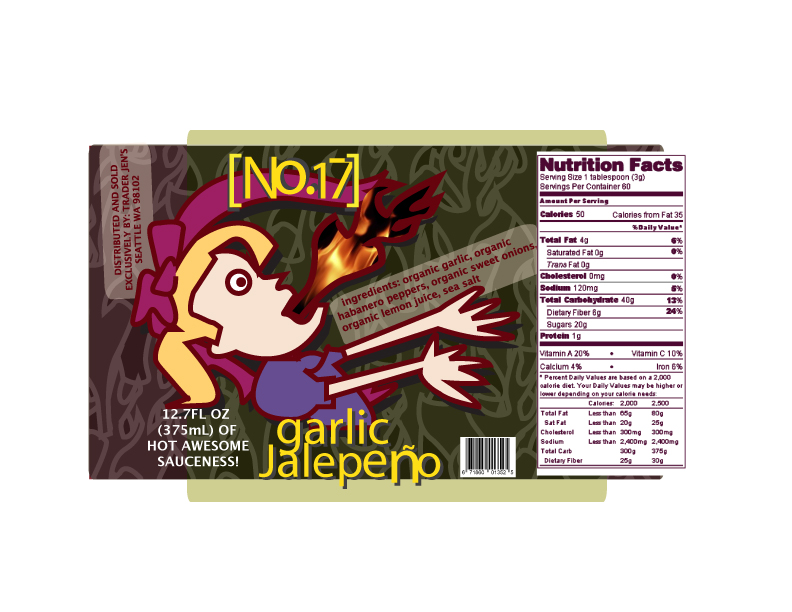
    Tom said that my label had too many saturated colors and the font left something to be desired. Set the scene, he said. Tell a story. So, after some edits and the use of a varying size san serif font, I will submit a different version.

    Update: 4-23

    New Version. Simplified and colored differently.

    Update: 5-4-12

    Post-critique:

    Notes: eliminate photo of flames, reduce stroke, and bump up presence of the brand, contrast

    Today, Tom invited his friend and packaging veteran Frank to help with the critiques. Frank said “You gotta solve with what ya’ got.” Even though the assignment involves a made up brand that you can alter at whim, as designers, we shouldn’t. The skill comes in the problem solving. If the bottle doesn’t seem to have enough room for more, perhaps it’s not that bottle that needs to change size. Likewise with the brandname.

    To said complimented a label in saying that the treatment “gives it a feeling like it’s from some place.” All of these touches, playing with the edge of the label, the font looking like it has a light source, those dynamic touches that make your product shout “please take me home, I’m so cool!” or quirky or with some delicious attitude.

    Tom gave a little schpeal about how retail characters are more difficult than meets the eye. You can’t just draw a figure and that’s it. Character is the game. The exaggerations, the specific motivations, the emotion. I want to make something that is engaging and compelling. I want to make characters that people love.

  • vancouver waterfall painting
    vancouver waterfall painting

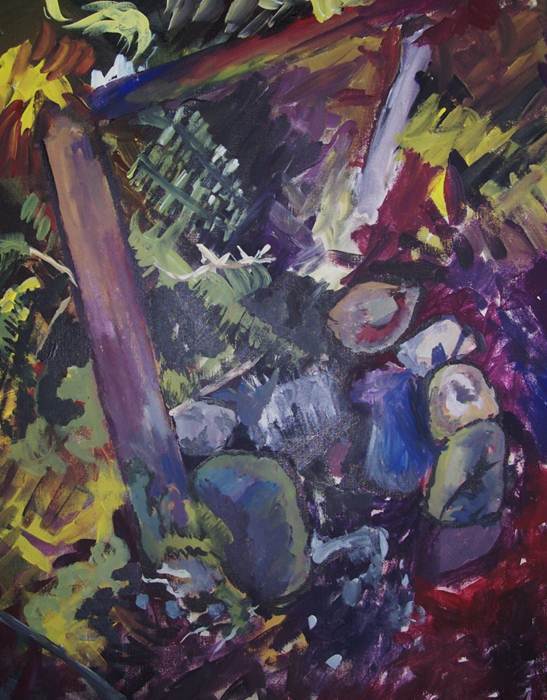
    Capilano Suspension Bridge is one of Vancouver’s top attractions. I went a few weekends ago and took a photograph of a lovely waterfall. Here’s my painting version of it. I feel like I am going to go back and add more detail, but I like the spontaneous strokes.

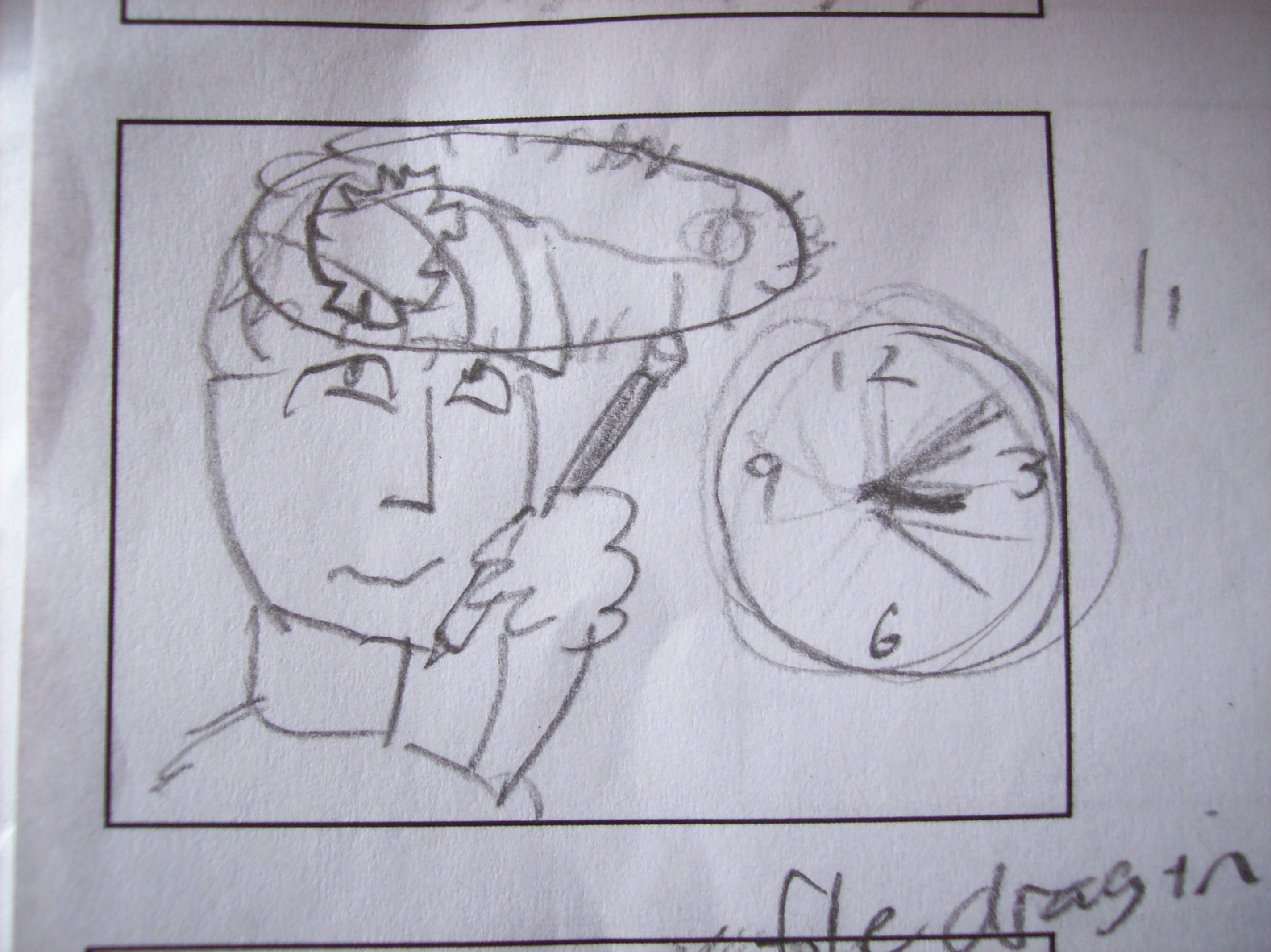
  • My New Media team of three (including me) worked on our storyboards for the video about Information Technology. (See last week’s post for details.)

    Today would be the second time I almost cried from a critique. The first time Jill looked at some underdeveloped thumbnails and called them useless and said that if I wanted to talk my way through a critique I should go to art school. I confirmed today that “artist” is a dirty word.

    When we presented our idea to Jill (we could have presented it to the jolly Robbie and Marc but they were just a little occupied and I shuddered when Jill sat in front of us.)

    I was already stumbling over my words, referring to my team as Team Puffinstuff, for no reason at all. Everything came out as a jumble, though I got through some of the story boards.

    She called me on the fact that we didn’t do as much research as we could have, but there were parts where she questioned the storyboard and I wondered how I should have done it. I argued with her assessment that I should have found out if they even use textbooks in the program. (I’m like of course they do! This is community college, we are as cutting edge as that can be, but that doesn’t mean that textbooks are gone forever.) She had said that they don’t do web design in the program on the third floor and the team and I knew this to be a falsity, but perhaps she was talking about web Design with a capital D.

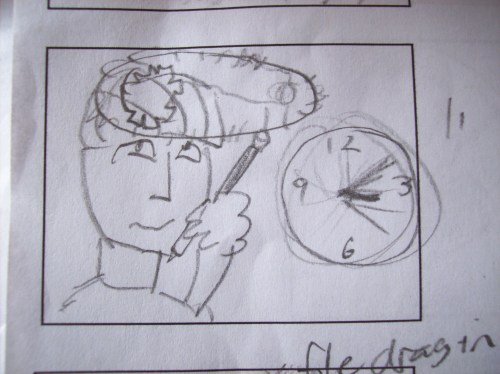
    She criticized a part of the storyboard where we had talked about comparing visually grabbing a book from a shelf and grabbing a server and she thought that the audience wouldn’t get it and it should be gone from the storyboard. She said that she didn’t want us to waste our time filming it if we could work it out on paper first. I wanted to scream. I felt my eyes burning half rage half tears. That’s not what the storyboard is for, I thought. It’s for forming ideas not the other way around. She said that she didn’t want us to waste our time. What happened to “make it work”? I told my team right then and there that we are not going to throw away an idea just because Jill didn’t get it but we can always delete the footage later. She took offense to that. I tried to explain that I meant no disrespect, but to be fully honest I don’t always trust her judgment. In my heart I firmly believe that as designers we are supposed to question authority and try to make something that people didn’t know that they could get. I think she thinks I am a rebel. She said that it wasn’t right to not edit for understandability to maintain “my artistic vision” (she said that with strong disdain) and I couldn’t help but boil. I am not that inflexible, but I do have a vision and I see in my mind how it will work.

    I think storyboards are kind of like dancing about architecture. You can’t see how mesmerizing video can be, how accessible it can be with pencil drawings, static and unfinished. But, I suppose her point made in a derogatory way was the lesson I will have etched in my brain because of this program: Graphic designers can never be free. They are forever handicapped because they must make sense.

    My team, especially Tim E. and I have struggled with how much of this movie is artistic dribble versus informative.

    Considering that it will be projected on a wall at a fundraiser gala with their music blasting, we are robbed of audio and their formal attention. What else are we do to other than play the artist card and make something conflated but beautiful?

    We revised our storyboard and we will again because a lot of what Jill said was true. We injected our research into the Storyboard, the Second, and it turned out better. More concise and related to the Information Technology department’s three branches, web design, applications support and network design and administration. As a point to revise for the shoot, we unified the overlaying metaphors for the various technological processes.

    I often eat my words about my assessments of teachers. When the experience is less than perfect, everyone says that real life is like that, so that’s great experience to solve problems. If I could handle the real world, I wouldn’t be in school. I admit I have been rude and unnecessarily insistent. I haven’t understood where the line is between a designer’s conviction and a student’s naiveté. I miss nap time, progress reports and smiley stickers.

    (Earlier Post Relating to This Project)