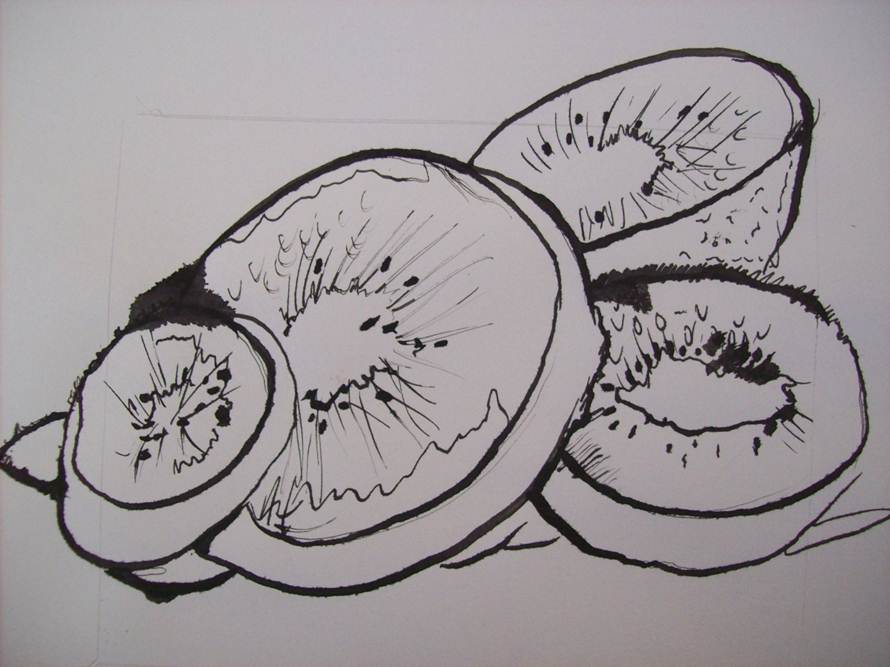
• I don’t sketch a lot.  It detracts a lot from the spontaneity of the work. But, I don’t think people want spontaneous design. I think that’s an oxymoron. Design is a mindset. It’s solving a problem, shaping an experience, optimizing environment. It may look spontaneous, and a couple of my teachers would assert that if it looks effortless, that’s good design. And sometimes it is the first thing you scribbled on a page, but many times it isn’t. That’s where sketching comes in.

    Sketching is extracting ideas from your thought process to something more permanent, as we all know the fleeting moment where you realize that you just forgot your fantastic dream that seemed so strange you thought you could never forget it. For me a sketch seems cosmic, like predicting the future. Showing a path of the future (if you believe the Many Worlds theory), it is just showing an option among many. That’s what creation is. We can acknowledge how the world can be any which way, animals with three eyes, or made of light waves, but the creation comes with putting it to paper (or canvas or writing or whatever form really). The creation happens when other people can refer to it as an idea over and over again. Where the fact that other people are thinking that there are 3-eyed animals is no coincidence but something that you suggested to them.

    A good sketch is something that will inspire you to make that suggestion more real. Each rendering that improves with some aspect of refining that idea is a step towards making a sketch a reality, making a suggestion a creation.

    This process is tricky. Jill would say “What do you like about this?” It is a matter of refining your design to the essential elements. She would say “What is working?” Each incarnation of your sketch gives different hints as to its true essence, but also, medium comes into play. When sketching with a pencil, the density of the marks can play with the light-darks of the design and indicate something very subtle but transformative to your design and as it’s being created you might not have thought it could be any other way and that cements a certain route in your process for the rest of the time. Perhaps you try to render that same idea using ink and brushes, the line quality and the saturation pushes to the forefront of priority and in refining that idea you try to maintain those qualities. I told Jill this idea about medium, the difference between sketching with a marker versus a pencil and she said that it didn’t really matter (I don’t know if she was tired and didn’t want to get into it), but of course her stance on computers in the process reflects this notion. I am merely stating that even if you start designing by hand drawing, I would heavily argue that medium changes your approach as you go. Each stroke and flourish look differently depending on the force and material you use in making it. A nice stroke can almost be an accident, a burst of energy and a flick of a wrist can be practiced and perfected over time, but is initially not fully under control. Line quality communicates emotion. Subtly, the line can indicate surety, boldness or more tentative energy.


    “In design dialogue, the wobbliness of the lines often expresses the degree of clarity of architecture thought. One does not sketch with a 6H pencil and a straight edge or make working drawings freehand with a felt pen. The refinement of a project is a step-by-step process of sharpening both the compression and representation of one’s image of the problem.” Nicholas Negroponte, the Architectural Machine


    The other side of the coin: playing to your strengths. I personally dislike the traditional pencil sketches because I don’t see myself as a drawer, someone focused on details, shading, realism, that sort of thing. I am a sketch artist, where each sketch calls out to me, “save me, save me, I am art, too!” and so naturally, I want to render each sketch in something more permanent and finished looking than pencil.

    As for sketching as a process towards a finished piece, I like its quick way of capturing an idea that would take words paragraphs to communicate. How round or lanky something should be, how it fits on the page, that sort of thing. I want to caption each sketch, for position only, FPO. I don’t want people looking at my sketches and thinking that the finished thing will look anything like that, because it won’t. The way I work, the floor plan may be the same, but the details, the smaller shapes will take a life of its own during the creation process. Sketching relates to storyboarding which is different than concept art. Storyboarding is just the structure under the story, angles and directions, a recipe for the first process (in a series between the start and finish of something truly something). Whereas the concept art is the mood board, the inspiration, the home base where you can rest to rekindle the flame of creativity, reminding you why you started in the first place– you had a vision of this thing that would exist with your help.

    Finally as a last tip, the rule of art, is if you feel comfortable doing it, it will show. If you were born with a mouse in your hand and have a firm hold in a process that reminds you of where you are in the finishing of a piece, that will work for you. The thing about painting is: you’re done when you create all the details you want in the painting. And that takes time and between painting the background and the first figure, you might realize that you need to add more of a table or something. Painting and drawing, you literally start from nothing. The lag between idea and art is longer than on the computer where a fonts and images wait eagerly for you to pick them. So, the execution is quick. That sense of time is warped. Working on a computer is fast, so it pressures you to think fast. Whereas painting is a slow endeavor and when you invest time, you want to make it good, so the decision time is longer, more thoughtful. I think that’s what Jill is talking about when she says go to the computer last. Don’t necessarily go to the computer last (there are fonts and research on the computer) but go to the computer speed of decision-making last. Sketching is not about the act, but the time spent not committing to a particular design and trying out (in a way that is quick and efficient) different futures.

    It’s also like trying on shoes. It’s comforting in the decision making process knowing what definitely didn’t work. I’ve had some shoes salespeople who said “try on this one, just to make sure you like the other one better.”
  • Meeting, the Film project (for more on this project, check out last week’s blog post)

    Co-directing this project with Pete, we learned a lot about the value of good vibes on the set. The amount of beer and silliness inherent in the production led to a great experience with friends in an interesting situation. The shots we got had a feeling of authenticity. Those moments of calm ritual, those moments of exuberance were only lightly directed. We had a storyboard/list of shots we wanted to get, but also there were shots inspired by the setting (the fireplace shot is such an addition) and other shots that were moments of interaction.

    Editing

    The first step in the editing process was to eliminate takes that were discontinuous (people weren’t wearing masks mostly) and takes where some people weren’t ready. After that, we took notes on parts in the takes where it is especially potent and must definitely be in the shot. Then, the sequence was arranged chronologically. After snipping this down, we wanted to make sure we weren’t missing any beautiful shots, so we made a track of video reserved for shots that were small and wonderful, moments of power. Whenever a part of the vid “dragged” during editing, we took a snippet from this track and added it as an overlay to that section. There were parts that were clumsy due to overlays and we took them back and breathed a sigh of satisfaction. It’s important to try it and see how it looks. It might seem cool one day and a little hokier in the next day’s editing process.

    This film was edited over the course of 4 work days. Plenty of time to rethink approaches, but not too much actually. I think this amount of time encouraged the decision process to flow with more deliberation. I think a lot of teachers and leaders understand that unwritten law of workflow: work will expand to fill the time before the deadline. Pete and I kept seeing other problems as we solved this storytelling puzzle. There would be lulls and jams that would be bugging our sensibilities, replaced by rhythm and framing issues followed by “is this too complicated?” We looked up information on what tools did what (the video module lessons didn’t stick as much as we wanted to) and found some useful knowledge about blend modes. And so, that’s how it went. Having two people in the editing process seemed valuable. That little bit of agreement giving the other the confidence in that particular decision.

    We were a quite the couple of hipsters when it came time to choose music to further inspire the cuts after we had a 2:40 rough cut. Our ears were graced with a smorgasbord of music that day. We considered choices literal, abstract, environmental and classical. Bizet was a candidate for quite a while, something balletic. I voted for Penderecki (after Pete played me a YouTube). It was so utterly creepy withe sound of bells and wind-caused creaking of metal. I mentioned how lovely Michael Jackson’s “Thriller” started and we considered Charan’s suggestion of Enigma, but Pete was terribly picky. He wanted something almost ironic, I deduced. After a couple of hours, I dictated the time was near to pick a song. At 5:40, I said, that’s when we settle on something. Twenty minutes after the anointed time, Pete showed me Doris Day’s “Que Sera, Sera.” I agreed with him. There was something so joyous in it that it wouldn’t be expected.

    A lot of times when editing alone, you can go on a tangent that leads to a broken place because it’s built on a direction that you hoped would work on the end and it didn’t pan out. It’s best to save versions you can go back to. Especially with video, there are perfect bubbles of finish product that appear and disappear when editing and there’s never a magic elf that will come out of a corner and gently guide your hand away from the project saying “good job. You have met all the criteria of the assignment and produced something new and valuable and complete.” I have to be the magical elf and say “okay, after we trim that clip and change the blend mode on that clip, it’ll be done.” And maybe it will and maybe it won’t.

  • Yoksabet

    View more PowerPoint from basementcat  (view small, low resolution)

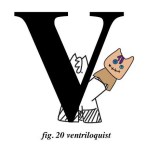
    I created this alphabet poster for my friend and muse, Dan Helton. We created this character named Yoks (short for Yokoso, I often call him, Mr.Yoks). This character is based off of Dan’s stuffed animal who is a baby horse. (Some people say pony, and some days I correct them, but other days I realize that I made the same mistake at first.)

    I made these comics as doodles during my classes and made them into a webcomic last summer. I have made small books and a shirt design or two. I’m starting to make an animation featuring Mr. Yoks. I’ve been toying with the idea of an alphabet. Given my new knowledge of Photoshop (which I think is the most facile program for image manipulation) and the free time of Spring Break, here’s the Yoksabet.

    I started by hand drawing everything with a fountain pen. I had Times New Roman in mind when I was drawing the letterforms. I wanted to integrate the letter with the figure. I think there was some subconscious Geoffrey Tory influence going on. (He argued that letters should reflect the ideal of the human body. However, in this set, the cross-stroke does not” cover the man’s organ of generation to signify that Modesty and Chastity are required before all else, in those who seek acquaintance with well-shaped letters.”)

    I was also inspired by an Alpha poster where the theme was birds. She used the “figure no. 13” when describing the birds (to make it obvious for people who couldn’t recognize bird breeds, I think.) I liked the formality of that contrasted with my cute baby horse.

    I scanned in these drawings and made them a template layer in Adobe Illustrator (that means locking the layer and knocking back the opacity) and pen tooled over the top. Mr.Yoks looks a lot friendlier when he’s clean. I added the letters as a separate layer. I copy/pasted all of these elements into a Photoshop document and through “layer via cut” I made each letter and corresponding Yoks their own layer. To integrate the drawing and the letter (there are instances where yoks is in front of the letter, behind it, or both) I changed the opacity on the letter and added a layer mask where the intersection of the drawing and the letter was. (The magnetic lasso was for quick and easy for this, but there are many ways to select the part you don’t want to show.)

    Some parts I added color. There are some parts that I added color in the Illustrator phase and others where I added color in the Photoshop phase. I like adding color in the Photoshop phase because it’s just like a coloring book, it fills the part between the lines (because I pixelated my images. I like working with pixels. Very straightforward. I had some difficulties colorizing in Illustrator because I didn’t want to make everything a closed shape. Most of the elements in the yoks’ drawings are stroke, no fill.)

    And then finally merging the layers to have drawing and letter inextricably together. Then I took those and rearranged them into a poster design.

    As Mr. Yoks would say, “Ta daaa!”

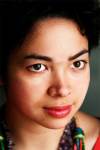
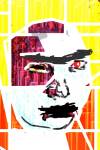
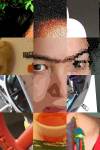
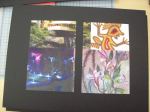
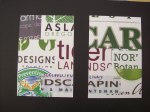
  • This was a fun project. A four-parter: untouched photograph, retouched photograph, found object/ filter utilization, and abstract.


    Some quick fixes to any portrait: brighten up the whites of the eyes and teeth, smooth the skin, eliminate extraneous hair, whether that is flyaways or stubble and use liquefy tool sparingly.


    Filters can be your friend or your friend in appearance. Using too many of them produces interesting affects, but if for the wrong occasion, they can be overdone. (I like the Ocean Ripple filter myself, but when can we really use that to enhance the realism of something. I rarely Photoshop underwater scenes, but there will be a day… and I’ll be waiting.)


    The found object portion of that photo was a great challenge. The goal was to find compositions that suggest the space you’re replacing. It’s a weird thing to forget (or at least to try to forget for a moment) what you are looking at and look at the shapes they make. I did that with my lunch and I think the other patrons of the sushi restaurant thought I had some sort of disorder where I had to rotate my plate a quarter clockwise five times before I could eat a bite and then I would have to rotate it again.


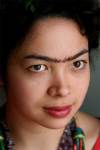
    Abstract art is a whole other world for me. It was very interesting trying to do something where I wasn’t even inspired. I started out with circles for eyes. A bunch of them and added layer effects, bevel, inner glow, outer glow, satin and drop shadow. I initially had a stroke on there as well, but everyone in design knows if you can do without a stroke, do. Strokes are for kids that still can’t color in the lines. Not like me, an arteest, who colors outside the lines and makes les statements. Then I decided I liked that and added color bars with the same layer effects for hair, but down the road I realized I liked that look (it looked like the buildings of Wizard of Oz’s Emerald City– the faraway view) smooth and shiny like crystals. I wanted some painterly-ness to it, so I had a texture layer of brush strokes. I only brushed part of the art board and then copy-pasted until the whole thing was covered (the wonders of technology!). Then at some point I traced my eyes with the pen tool, brushed loosely my nose and mouth. It needed more, so I applied a technique I experimented with in the book cover project where I make a Mondrian-esque layer using the shift key, a round hard brush and the paint bucket for some of the spaces between the black abstract wacked grid I was making. Make that a blend mode (I love “vivid light” now) and you really have something to play with. I messed with the order of the layers, entertained by the various versions of my obscured face. I messed with the order of the layers like they were players on a baseball team and each player had a chance at bat. One of the layers made one of the eyes I took from the original look red and strange, so I kept that mode. And that’s kind of how abstracts are made. Things start to look weird and there becomes a point when you start to like it. It’s a great lesson for creation, because sometimes, you don’t feel like making the thing you must make. Sit down and do it anyway. There’s a moment in the process where the material speaks to you, where your mistakes become charming details and you see things that can be tweaked ever so slightly to create meaning. That’s the fun. When all of it falls into place as if it was magnetized and just needs a little jostling to create order.

  • In class last Friday, we received the assignment brief for the final in New Media class. The assignment is called “The Beehive Blender Project.”  The first step was to divide into teams of three, preferably with all the branches of the program represented (publishing arts, photography and graphic design).  Then Marc had every team submit an idea for a prop, character and line on the sticky side of a post-it. Facing the white board, each group picked from this newly created random group of props and such and there is now a video (also could be a series of slides) 1-2 minutes long due next week friday based on these three things.

    My group has been assigned the task of making cohesiveness out of “Beer,” “SailorMoon, Champion of Justice” and “Are your legs tired? Because you’ve been running through my dream all night.”

    Brainstorming

    Initially, we all sat around and separately came up with ideas for the movie. I was practically married to one where SailorMoon is running through a forest and wakes up and realizes she is not SailorMoon and starts to cry.

    Pete suggested we head to the whiteboard to do some better collaboration. (My last video, I felt a little disjointed because we didn’t come up with the idea as collectively — aka, I wasn’t there when we storyboarded for the second time.)

    How to Brainstorm: (Just one method of many)

    Firstly, divide up the “bones” of the project into lists where you say whatever comes to mind when thinking of that particular word/phrase. We had a word association list for “beer,” “SailorMoon,” “Legs tired?,” “Dream” and “All Night.”

    Then, take that list and get rid of the ones that don’t resonate with some if not all team members. Some of them I wasn’t too keen on, but after an explanation from the people that liked it, it sparked a good deal of conversation and ideation. After you cull the list, each team member circle (or otherwise mark) two from each category that they especially like (more than one person can pick the same thing, for example, every one in the group picked the phrase “party people”).

    Then stare at those phrases and keep trying to find connections between them. We had an idea for a hallucinatory informercial, Belgian SailorMoon and I mentioned puppets before we came onto the idea of “drinking party” which later morphed into “Secret Society Meeting.”

    The Pitch

    We presented our idea to Tim (because a staff member had to sign off on it, to guide us, to keep us safe from our own ideas) and he said that he was with us until we mentioned “beer and pictionary.” He said he was more intrigued by the “Secret Society” aspect, Eyes Wide Shut type of stuff and we should find ways to make everything ritualized. (To be fair, we had that idea, but we wanted to break down the severity with pictionary.)

    The Party

    (Pictured above) Aftermath of the party. We invited people to come over to my house for beer and fake rituals. It was perfectly attended. Ten people filled my living room nicely. We bought pizza, beer and candles. We made masks for each attendee. We played party games and had a bit of a trouble because one of our teammates, the one who borrowed a DSLR from the school, did not arrive (and wouldn’t– for good reasons, mind you, but at the time, we did not know if he’d show up later or what.). My housemate (and lifesaver) Jon brought his Go camera (or something named to that effect) and it’s a detachable helmetcam. At first, I was not sure why he brought it, our camera man would be arriving any minute, but around 8:30, it became the best idea ever.

    Life is beautiful like that. Art is like that. At least for me anyways. If life spills ketchup on your canvas, make it blood. (I just came up with that… needs work, I know.) So, Jon got the shots we needed, we circled him, all of us wearing our haunting masks, eerie in their frozen gaiety, with a chandelier and a fireplace blazing with light.

    Everyone was more than cooperative, seeing the humor in the fake rituals, everyone eager to do silly things. I think wearing the masks, the guests felt anonymized and in a way liberated and at the same time, united.

    And this week, we’ll edit the footage, do some music over the top, add subtitles, and that will be the story of our success with the Beehive Blender Project.