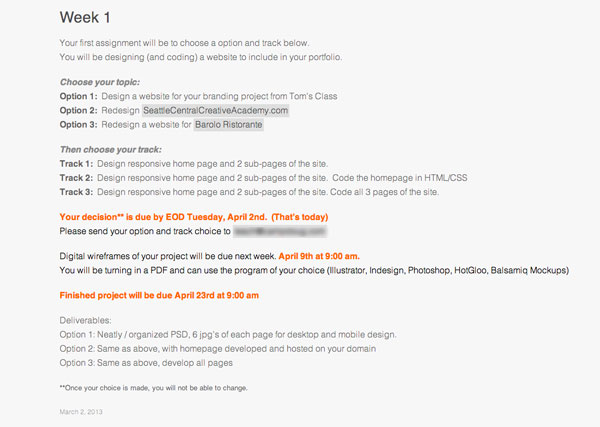
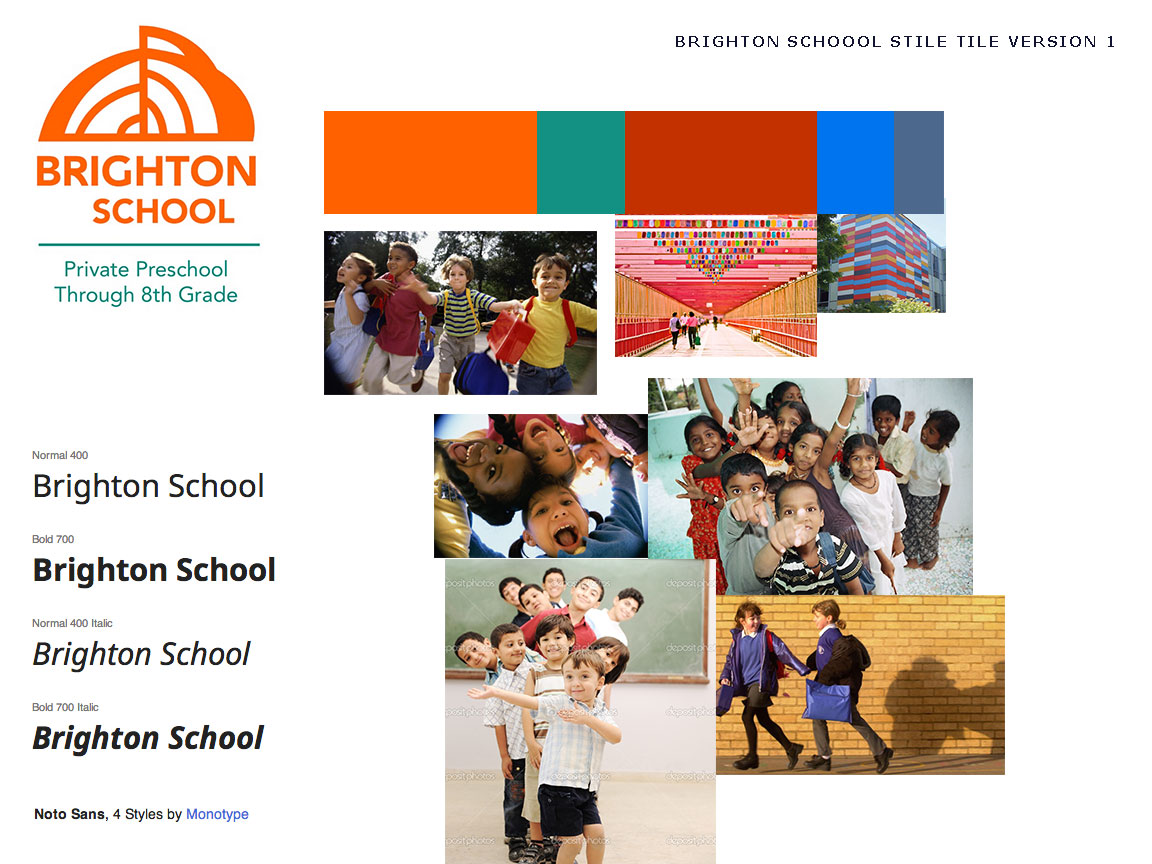
Today was the first day of website design and production class. I don’t know if there’s an official class name and to confuse it a little, it’s a split class where both sections take turns with the teachers and so this session is split with Marc for his business class. I’m opting for option 1 track 2 and build a responsive website with working homepage and designs (and mock-ups in photoshop) for 2 sub-pages for my branding project from last quarter, Brighton School.
Current solution for Brighton School’s Website
Phase 1 of Web Design
1. structure information with user-centered considerations (Site Map) *Research the competitors (Links) and content (html)
Brighton School | Private Preschool Through 8th Grade. I have started my Wordpress build. I’m going to continue to gather content. I’m using wordpress because this site is going to need up to date posts for community events and mentions in the press, etc. WordPress offers an easy to use interface that the client can use to update and add new information.
4. understand mobile strategy and other media requirements Client wants 3 layouts– mobile, tablet (landscape), and desktop. I think that teachers’ tool is the tablet. Great for on the go teaching, taking attendance, I think it would be a nice thing for the teachers to look at the website on their tablets and have a great experience.
5. Users: audience, demographic. Who is this for? How should that influence the website? I realized that I wanted the website to appeal to the students at the school as well as the teacher. A school. It’s an organization for kids after all. So I’m looking at media that relates to that demographic and taking visual cues.
(I was thinking about a script for an upcoming video project when I thought of this. I though it was interesting to read later. I’m about to have my last quarter at design school and it kind of feels like the end of a duration in a coccoon and I want to capture that feeling of anticipation.)
Hello. I’m Kat Countiss. I’m a graphic designer. At least, that’s what I want you to take away from this. See, I am beginning to form this opinion of what the word “design” means. Design with a capitol “D.” It’s the same as Art, with a capitol “A.” I want to validate all attempts at making the world more beautiful and purposeful and call a lot of things design and art, but it remains that these disciplines are ones that need societal evaluation before deemed successful. That is something I haven’t had a lot of. In design school, most of the time you make up a product and parameters. Your clients are your teachers and often less invested in your product than a real client. Sad to say, but true. These people have to wrangle twenty proto-designers and need to keep a distance from all of the projects to be able to attend to them equally.
Mostly, this means I don’t know truly what it means to be a designer. To design something that suits my client’s needs, makes them happy, makes them feel like I’m worth the money they pay me. There’ s a thing about investment that teachers aren’t doing. They aren’t taking that risk of paying someone to do something that hasn’t been done before, or done well before. There’s a gamble in that and a joy when that gamble pays off and there’s a sense of victory and accomplishment from being the client in a well-done project. And that satisfaction is transmitted to the designer as well, creating a confidence unlike anything enjoyed in school.








 Kismet Arts Tangent