• _kern the headline   _optical/metrics   _look for the challenging letters (inclines are problematic   _go word by word   _match the ones you’ve solved (i.e. if there’s an od -lowercase- that you’ve got down, the same kerning measurement works for ac-in some fonts)   _kern body text by going to your menu, see justification   _start with letterspacing   _then wordspacing   _and rarely when the situation calls for it, itsy bitsy changes to glyph scaling

    Jason says: you can “fake justify” by manually balancing through kerning line by line.

    As a note: Never double return. There’s a button to do the heavy lifting, making the spaces between your paragraphs as much as they need to be.

    Jason also says: In the real world, save everything. There will be a time when the Client says I liked it better two weeks ago and it’s always when you’ve written over the document and never when you’ve saved every step of the way.

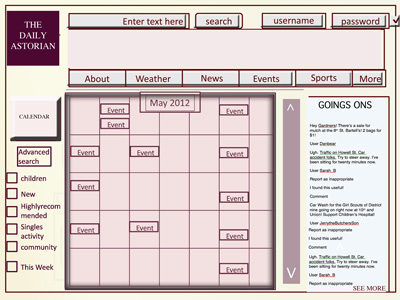
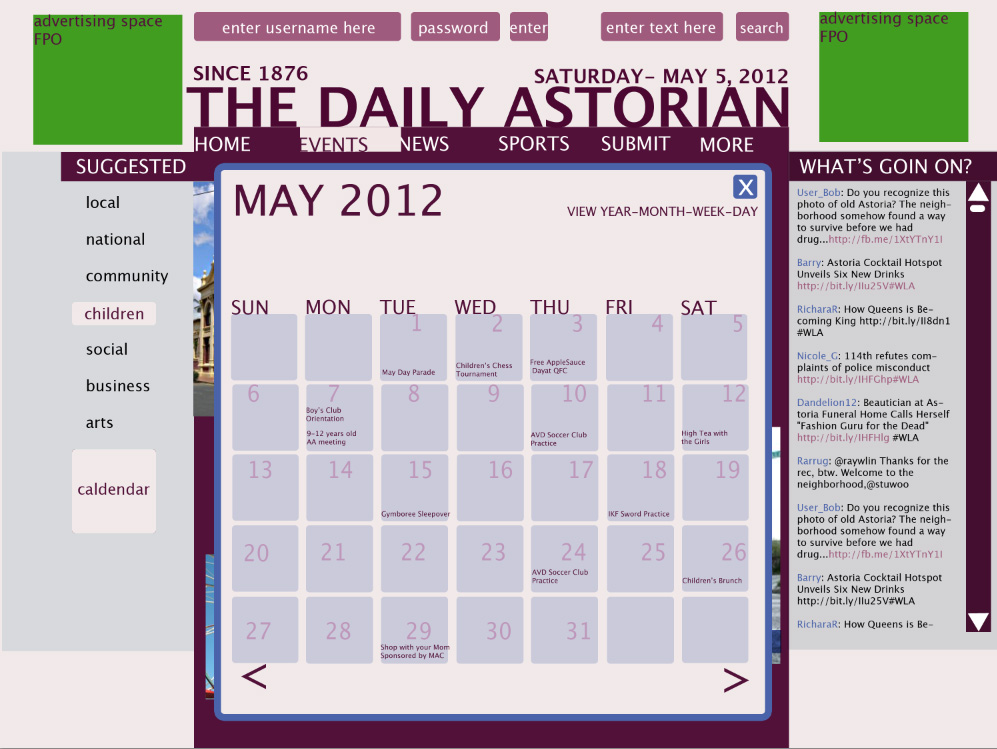
  • (Above: My designs, first attempt and Final)

    Tim’s Tips for Web Pages (At least what I could glean from all the friendly teacher-y snarky.)Create a header-create icons-you have levels to help you with your hierarchy- Mockup, don’t put ads in- also consider ways to overshadow ads, like color- typography- tutorial… ew.- make it your own- grouping- continuity- drop shadow, also ew. – Color scheme! – Define rules for yourself- get as much content on the home page as you can so people don’t have to go digging for it someplace else- colors indicate links- keep in mind size translation during creation. Fonts look big when you’re zoomed in, but remember screen size is what you’re looking at in the end- widows happens in web design, don’t worry, there’s nothing you can do about it. – Centered type disrupts the flow off the grid- integrate color- subtle rules help define space- indicate navigation

    For some reason or another, I thought this design a web page thing would be easy. Bevel some boxes and label them and you’re half way there. I was very wrong. I was trying to squeeze more minutes out of the morning to finish these main screens, but perhaps that franticity was the thing that made me miss details. I had trouble because the text box was set to All Caps and I didn’t even think that could happen without my knowledge. I had trouble because I didn’t start with a grid. I tried my best to integrate my horsey looking wireframe, but as Jason says, crapola in, crapola out. When I sat there, with a thumb drive full of bevels and inner glows and drop shadows (with a sprinkle of a calendar and news headlines) I realized I couldn’t present this monster I thought could pass for design. I went back and started over using all the tips from Tim’s remarks on the other students’ work. Its more fun and a lot easier when you have guides and “snap to guides” to make something look professional and design-y.

    (Earlier Post Relating to This Project)

  • I presented these wireframes made from last week’s task flow items.

    Post-critique:
    Always funnel information. The scope should get narrower as the user continues his search for information. I made the error of giving options at a certain point. The time for options is in the beginning as a way to direct the user to what they are looking for. I will put the “advanced search” options on the event page directly instead of only as a calendar modifier. I’m eventually going to make checklists as a way to better self-critique. “Does the information narrow in scope as the task flow progresses?” If that’s not checked then that means that this is not user-centered design.
    Also, Tim said I should have event categories so you can see all of one kind of a event, like community events.

    There’s a feature on this wireframe where you can see the details of the event, push the review button and then you can see the reviews and push that button again (it toggles from being a See event details to a See Reviews button) and Tim said that was confusing. A ToggleTab uptop of the window would make more sense there.
    Our homework for today is to design the main screens, as Tim says, “ready-to-click.” He also says to use Photoshop because it’s pixel-based. Any other software would be the wrong tool. Never use IndEsign he says because it’s not made for web design. The graphics aren’t readily cut from the file as it is in Photoshop. We should use vector shape tools. And control their size using vector shape tools. Using good ol’ command T will distorted rounded edges. And rounded edges seem to be the way to make some delicious buttons.
    I always do my Tim assignments the morning of his class. I think doing them in an intuitive and simple quick way is a good solution to the particular structure of this class. So far it has been presenting the homework and then receiving feedback on improvements and then getting the assignment for the next week. I like this class structure because the edits you make after the presentation matter. Some assignments we critique but then don’t get to immediately correct our work and then present again. We’re presenting all of this material again in a cohesive overview presentation of the project. I’ve noticed a lot of students getting frustrated with the teacher when he corrects their task flow designs acknowledging that smart people might get it, but this is a Dorrito-eater kind of world. That has been the theme of this quarter so far (as Tom will tell you) sometimes it can be too Design-y. Something you don’t notice because you were there since its inception. You’re not approaching it like a newborn lamb, but rather its mother who has seen it gestate and birth and know that it’s a lamb.
    I’ve never had classes like that. So explicitly, see what you do and then we’ll teach you how to do it. I think it works for my brain and as art classes go I think it allows for the pressure to be a little lessened. It gives the student a little breathing room, knowing that it’s not going to be perfect, and a little playing room because the teacher is not expecting perfection. You can experiment with weird shapes and strange characters and make a made up assignment kind of fun. I realize that I won’t have so many opportunities to design without worries like I do in this program.

    (Earlier Post Relating to This Project)

  • A lady came into my dry-cleaning shop today (my part-time job currently is at a drycleaners) and she just graduated from business school with a minor in information technology. I was motivated to talk to her because I am still working on the copy for this video I’m making about IT. Is there a thing called coincidence? I think that’s how the world works. We are looking for answers and they present themselves.
    Lately, I’ve looked at my experiences as raw material for art product later and I wonder how genuine that is. Do other people have underlying motives for socializing? Is there a pure joy in other people that I’m not aware of? I wish other people could get integral pieces of what they are building from me. Perhaps that is the joy of my choices that I have found an occupation where my world is so integrated, I live with interspersed production. I don’t leave work at school or at a job (I am looking for one actually) but it becomes part of my menu, when I can pause and think, “what do I want to think about?” my projects pop-up as something that can always use some contemplation. I have done that many times with this IT project. And it was using everyone around me as walls to bounce off of that allowed it to flourish the way it has. My housemate looked over the second rough draft (that no one else will see because it has already become the first half-polished draft) and said that I used too many buzzwords like information highway and imagination. I am constantly reaffirming the main strategy that I know I need to implement in my projects and that is authenticity. It has to feel real, natural, something smooth. So much of advertising is selling something that its recipients can no longer tolerate anything that has too much of a punch. If it has a punch, it has to be loud and provocative and extreme like camp.
    As filmmaker Akira Kurasawa said, “To be an artist means to never avert ones eyes.”

    (Earlier Post Relating to This Project)


  • Today, my team presented the initial deliverables to Jill. (Chris was at a conference.) We had our team name, team logo, prototype logo, concept, design brief and mood board. She approved it saying that the timeline and the logo needed finessing and the rest of it was in an unfinished state, so it was a safe assumption that there is still a long way to go to complete this assignment. You could tell that she was happy with the idea itself and excited to see where we’ll take it. She seemed inspired by it, too. She seemed to bubble with ideas, but she constantly reminds herself that she really ought not to give the students ideas.


    The assignment: create identity materials for the branding of the summer and Evening non-credit classes for Seattle Central Creative Academy.


    We assigned roles and deadlines for all the components, the logo, buttons, tee shirt, web pages and more. I am now the Project Manager. It’s a great feeling because I had some difficulty with this role last quarter and I already feel the rewards of some hard lessons learned. I have a schedule delineating when a project gets started, reviewed and completed and we have a week I noted for finishing and finessing (Jill’s suggestion.) My team is responsive to feedback and so far has delivered promptly. I think it’s going to be a great team effort.


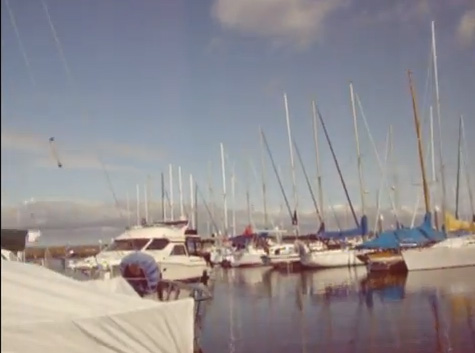
  • I went with the University of Washington’s Yacht Club on their Spring Trip to Blake Island. An island that you can only get to by boat. We went on a keel boat with winds about 2 knots at most. We motored most of the way there, but spent about three hours slowly tacking, zigzagging back and forth across a part of the Puget Sound, looking at the Space Needle, its top painted “Galaxy Gold” for their 50th anniversary. Our crew was very mellow and on the way there and back, we mostly sat quietly and enjoyed the gray calm and the occasional accidental tack. When the person at the steering wheel doesn’t watch where the wind is blowing, the winds will decided to push the sail to the opposite side of the boat and we have to adjust the ropes tied to it accordingly. The Yacht Club arranged for a group camp site and a Salmon dinner for the evening. Dmitriy and I fell in with the Russian group (and their American friends) where we enjoyed Russian Standard Vodka and some Sailor Jerry. We had a brief interlude with what appeared to be the Crème Brulee subgroup of the yacht club. They had brought little brulee bowls of crème, poured some sugar and fired away at it with a little travel torch they brought. They all had something to say about the joys of cracking the brulee surface.

    We woke up too late for the pancake breakfast. I seem to never be in time for those sorts of things, so I wasn’t disappointed. We were on duty for making sandwiches. Quite the operation, making about 200 sandwiches. The sail back was about the same as on the way there. 3 hours in, Skipper Skip (his name really is Skip!) said “bored? Alright, we’re going to motor in.” Music to my ears. Not that I don’t like sailing, but this is the hardcore kind of sailing, combatting boredom when you have no place to go.

    I filmed this using my point and shoot Kodak share camera and edited it using Windows Live Movie Maker. In the editing process, I clicked the button that said “Auto-movie” and it cross-faded my clips together. I changed the length of most of my clips to a few seconds, deleted ones that ruined the flow and voila! My weekend in a video nutshell.

  • I am exhausted. This week has been full of due assignments. I don’t remember what all was said in the critique. One girl said that the text was one the screen longer than the time she needed to read it and it irritated her. I have irritated someone with my video. It’s true that she and others said that it was good, but I kind of shut down the moment she said the word “irritated.” I wish I remembered what else was said. I think something about how it was distracting when the overlays worked against instead of for the vid’s message. I love the movie. I think the parts that are discordant are part of its jammy charm. I like that it pours out like a bad headache. That’s what technology is to me, a blur, a mess, a series of layers that somehow connect to create most of what I love about culture, information and connectivity. The good and the bad and certainly the ugly. I didn’t get as much satisfaction from presenting this as I did the other film. Was it that no one laughed? I think that was a part of it. Making serious things, people enjoyed the metaphors. I heard some people say that they were strong. Good, I thought. That weariness of producing something this time overshadows my pride.

    (Earlier Post Relating to This Project)

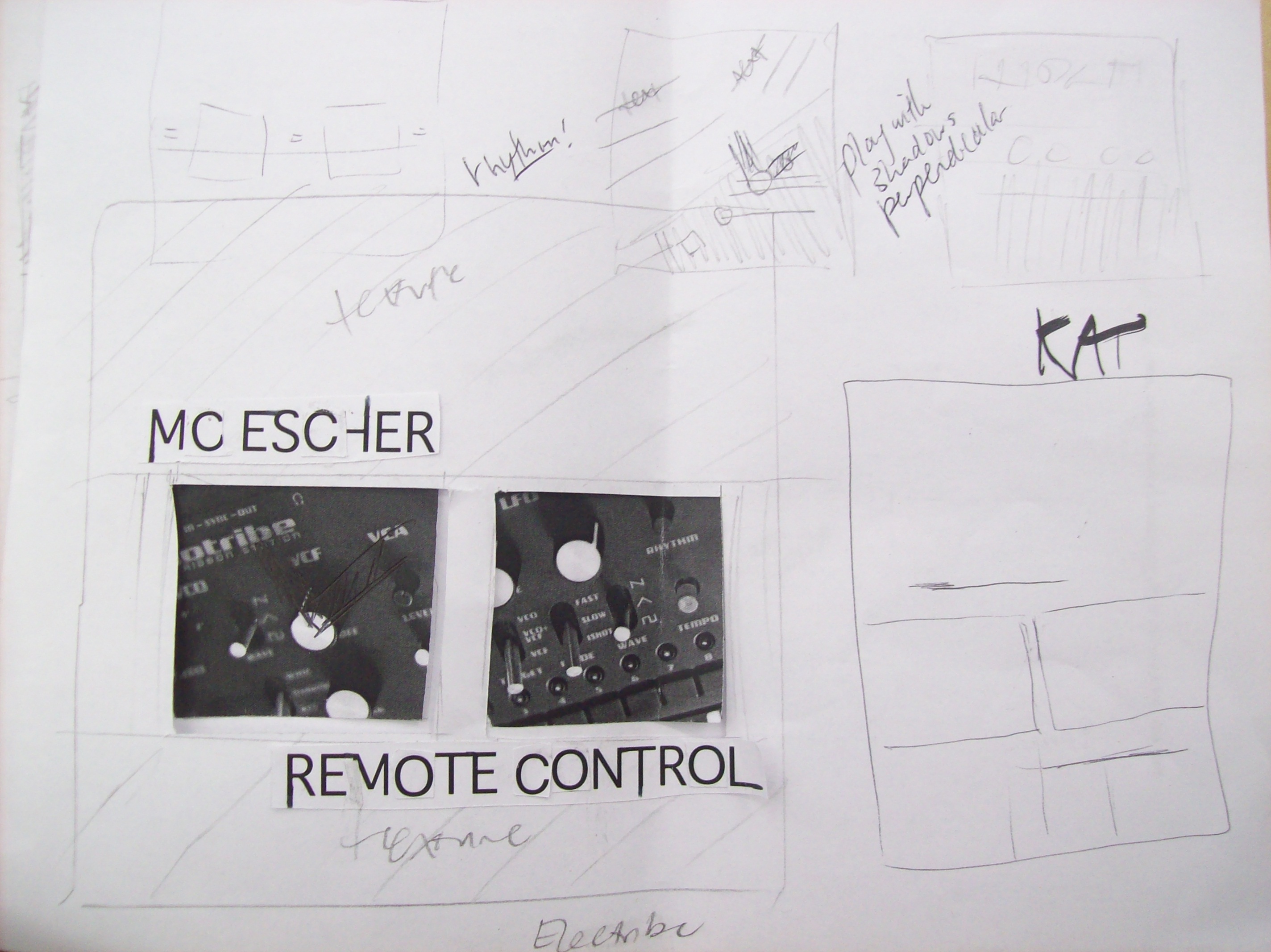
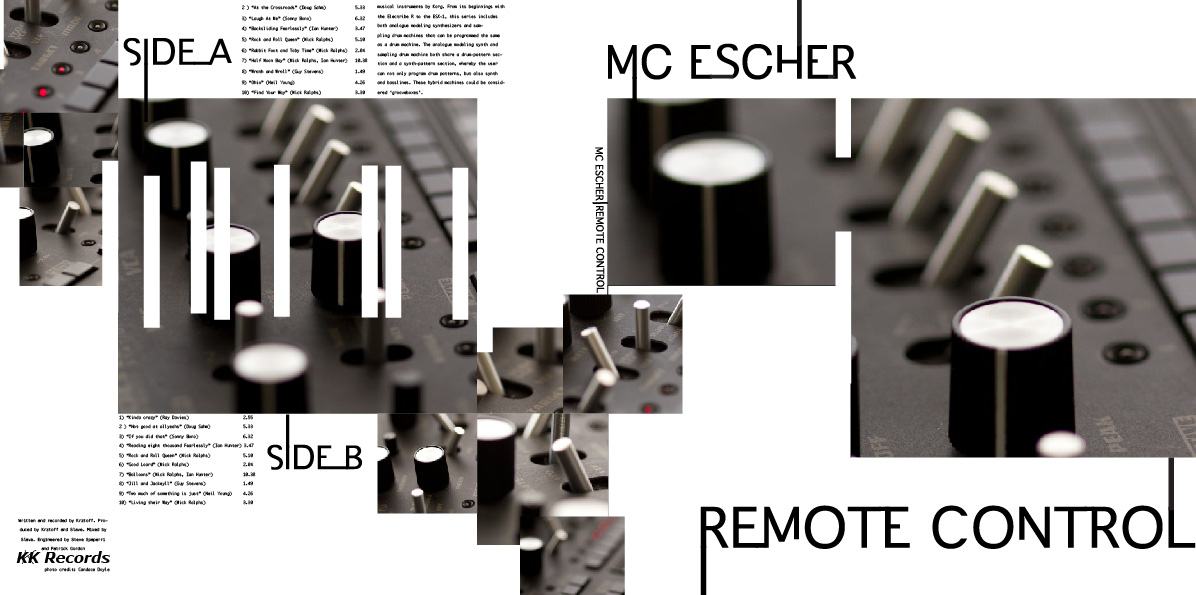
  • (this is for a made up album featuring the photograph(s) of an electribe/monotribe, a collaboration with the photography department)

    1)    Thumbnailing: It’s interesting how the teacher commented how we weren’t ready for critiquing these thumbnails because the lack of typography sketches. How developed do thumbnails need to be? Every boss has a different standard, I think. I can’t really understand sketching out typography. I can understand printing out bit of fonts that are inspiring or the base for flourishes or what have you, but unless you’re designing new typefaces, I’m not going to labor over the shape of a standard Helvetica “D.”

    2)     grab some fonts you like, add some adjustments to integrate it into the idea

    3)    consider the mathematics of what you’re up to. With sketches, there is no perfect circle, but maybe denoting that the width of the circle matches the height of the header is helpful.
    Update 5-10-12:

    I finished this design yesterday after some extra time and critiquing from some of my classmates. When I started out, I had thought that unformatted blocks of text would help convey the mood of messy techno, but I am much happier with the solution I found here. Jill during the critique of the original sketch emphasized ratios. She said to keep in mind some kind of consistency when laying this out. After my initial attempt, I added structure (read: tabs) to my copy, organized it, side A, side B, made some display text in illustrator and arranged the photographs to flow instead of float. I got lazy and made a white box to have consistent margins instead of moving the pictures around and during this process, one of these boxes got on my photo, and I liked the way it seemed to punch the photo. So, I took it there.

    A lot of teachers will emphasize that the computer is a refining tool and not an ideation tool. People go to the computer immediately after getting an assignment and try to churn out something based on what they can do with the program rather than what they can imagine. A part of designing with the computer is understanding that just because the lines look straight and the image crisp, it doesn’t mean your idea is as polished as what you see on the screen.

    When I sketch, you can tell by the line quality that there is ways to go, one of the few but effective cues that denotes progress. The hardest part about being a creative is to keep pushing your idea until it becomes fabulous.